
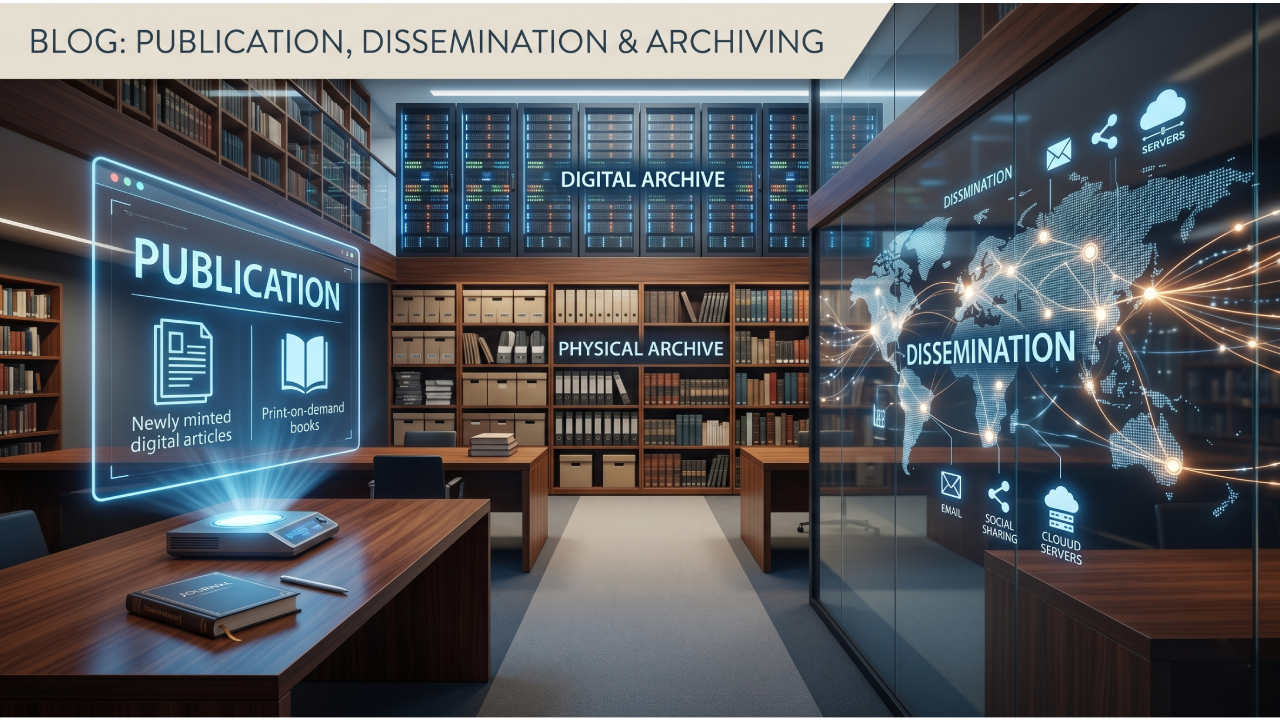


Transforming Research into Enduring Institutional Influence
INTRODUCTION: FROM KNOWLEDGE TO IMPACT
Research, no matter how rigorous, holds limited value if it remains confined to internal documents or academic circles. The true strength of intellectual work lies not only in its depth but in its ability to influence thought, guide institutions, and shape public understanding over time.
The purpose of this chapter is to outline how the Research and Intellectual Development Wing ensures that its work does not remain theoretical but is systematically published, disseminated, and preserved. This process transforms isolated research into a growing body of knowledge that can inform institutions, guide decision-makers, and contribute to long-term civilisational development.
FORMS OF INTELLECTUAL OUTPUT
The Research Wing will produce knowledge in multiple formats depending on the nature, depth, and intended audience of the research. These forms are not rigidly hierarchical but functionally distinct, each serving a different role within the broader project of civilisational renewal.
1. Research Papers and Analytical Reports
Focused studies on specific topics — geopolitical trends, economic systems, identity formation, or institutional design — constitute the primary output of the Research Wing. These papers form the intellectual backbone upon which all other formats are built. Rigorous in method and precise in scope, they are intended first for internal use and scholarly engagement before wider dissemination.
2. Policy Briefs
Concise summaries designed for policymakers and institutional leaders translate complex research into actionable insight. Policy briefs are deliberately condensed, stripping analytical depth down to its strategic core without sacrificing intellectual integrity. They represent the Research Wing’s principal mechanism for engaging those with the capacity to act on its findings.
3. Books and Monographs
Research outputs will be translated into books tailored for different audiences — from accessible narratives for general readers to advanced scholarly works for researchers and policymakers. Books extend the reach of foundational research across generations and serve as the most durable vehicle for transmitting an intellectual tradition.
4. Concept Papers and Strategic Notes
Early-stage frameworks and exploratory ideas will be circulated as concept papers. These documents do not carry the evidentiary weight of published research but serve a vital function — they introduce intellectual directions, invite critique, and seed the internal discourse through which stronger frameworks eventually emerge.
5. Archival Documentation
All research outputs, including working drafts, superseded frameworks, and background studies, will be systematically preserved. Archival documentation ensures that the intellectual journey of the organisation remains recoverable, preventing duplication of effort and enabling future researchers to build on prior work rather than rediscovering it.
STRUCTURING KNOWLEDGE FOR DIFFERENT AUDIENCES
Knowledge is not neutral in its accessibility. A research paper written for specialists cannot be handed to a twelve-year-old without mediation, nor can a children’s storybook substitute for the analytical rigour required by a policymaker. The Research Wing must therefore develop the institutional capacity to translate its outputs across registers of understanding without corrupting the core of what is being communicated.
The principal audience tiers are as follows:
Children — simplified, illustrated content that builds foundational worldview without introducing complexity beyond comprehension.
General public — accessible books, long-form articles, and narrative journalism that make research findings part of shared cultural discourse.
Students and researchers — detailed analytical work, citation-rich studies, and methodological transparency that meets academic standards.
Policymakers and institutional leaders — concise strategic documents that prioritise applicability and directness over scholarly elaboration.
This tiered approach ensures that a single research output can be transformed into multiple formats without repetition of effort. Effective knowledge management means that each layer of adaptation deepens rather than dilutes the original contribution.
RELATIONSHIP WITH THE MEDIA AND PUBLIC DISCOURSE WING
The Research Wing and the Media and Public Discourse Wing operate in distinct but complementary domains. Their relationship must be carefully maintained to preserve both intellectual rigour and communicative reach.
The Research Wing produces knowledge: intellectual frameworks, evidence-based insights, and structured analysis. The Media Wing translates this into public-facing content — documentaries, articles, podcasts, visual storytelling, and broader public narratives. This division of labour ensures that research accuracy is not compromised by the demands of engagement, and that communication does not become untethered from an evidential foundation.
In practice, this relationship requires sustained coordination. Research outputs should be made available to the Media Wing in forms that are usable — not as raw data or jargon-dense studies, but as structured summaries accompanied by the fuller supporting documentation. The Media Wing, in turn, should communicate its audience feedback and reception data to the Research Wing, enabling researchers to understand how their work lands and where public misunderstanding persists.
Where the Media Wing develops original content — editorial commentary, investigative journalism, or rapid-response analysis — the Research Wing may serve in a consultative capacity, ensuring that such content does not depart significantly from established analytical positions. This consultative role is not editorial oversight but intellectual support: a relationship of mutual respect rather than institutional authority.
KNOWLEDGE DISSEMINATION CHANNELS
To ensure wide and effective dissemination, research outputs will be distributed through multiple channels. These channels are not ranked by priority but by function — each reaches a different segment of the intended audience and operates within a different logic of engagement.
- Digital Platforms
Websites, research portals, and digital libraries form the primary open-access infrastructure for dissemination. They ensure that research is globally retrievable, persistently available, and searchable across topics and time periods.
- Book Publications
Books tailored for different audiences — from foundational texts to advanced policy works — provide depth and durability. Physical and digital editions ensure access across different contexts and reading environments.
- Podcasts and Audio Platforms
Research insights may be communicated through podcasts, discussions, and long-form conversations that make complex ideas more accessible. Audio formats are particularly effective in reaching audiences whose primary mode of engagement with ideas is listening rather than reading.
- Daily News and Analytical Updates
Regular updates interpreting current events through a research-driven lens help audiences understand ongoing developments without being overwhelmed by the unmediated flow of information. This channel bridges the gap between long-term analytical work and immediate public discourse.
- Documentaries and Short Films
Visual storytelling formats translate research into engaging narratives for wider audiences. Documentaries in particular are capable of bringing abstract analytical frameworks to life through human testimony, archival material, and geographical specificity.
- Satellite Broadcasting and Media Networks
Over time, dissemination may expand into large-scale broadcasting platforms to reach mass audiences across regions. This channel requires significant infrastructure development but offers the broadest possible reach, particularly across populations with limited internet access.
- Academic Collaborations
Partnerships with universities and research institutions extend the credibility and reach of the Research Wing’s work. Joint publications, co-authored studies, and participation in peer-reviewed discourse integrate the organisation’s outputs into established intellectual networks.
- Conferences and Seminars
Scholarly engagement and intellectual dialogue — through conferences, symposia, and public lectures — enable the Research Wing to participate in live intellectual exchange. These events also serve as recruitment and networking opportunities within the broader scholarly community.
- Institutional Briefings
Direct communication with policymakers and organisational leadership, through formal briefings and strategic presentations, ensures that research reaches those in a position to act upon it. These engagements must be carefully tailored to their audience and must resist the temptation to oversimplify in pursuit of access.
- Multilingual Translation
Ensuring accessibility across different linguistic regions is not merely a logistical concern but a civilisational commitment. Research produced in one language must be made available in the primary languages of the four target regions — and, where resources permit, in the secondary languages of their constituent communities.
ARCHIVAL SYSTEMS AND INSTITUTIONAL MEMORY
Without preservation, knowledge is lost. Civilisations have repeatedly suffered the consequences of intellectual discontinuity — libraries destroyed, traditions interrupted, frameworks abandoned before they could mature. The Research Wing has a responsibility not only to produce knowledge but to ensure that knowledge survives the inevitable disruptions of institutional life.
The archival infrastructure of the Research Wing will include:
- Digital archives with redundant backups across multiple servers and jurisdictions.
- Indexed databases enabling retrieval by topic, author, date, region, and thematic category.
- Historical records capturing the intellectual trajectory of the organisation — including superseded frameworks and the reasoning behind significant analytical revisions.
- Research repositories maintained in partnership with academic and institutional allies to ensure that no single point of failure can erase the accumulated record.
Archival systems serve three distinct functions: continuity, across generations of researchers; accountability, enabling the organisation to trace the origins and development of its analytical positions; and efficiency, by preventing duplication of effort when existing research already addresses a question under renewed consideration.
QUALITY CONTROL AND INTELLECTUAL INTEGRITY
Credibility is an institutional asset that is built slowly and lost quickly. The Research Wing’s long-term influence depends not merely on the volume of its output but on its sustained intellectual integrity. A single poorly substantiated publication can undermine years of credibility-building.
All research outputs must meet the following standards before publication:
- Evidence-based conclusions derived from verifiable sources and transparent methodology.
- Internal peer review by qualified researchers within the Wing, with documented reviewer comments and author responses.
- Methodological consistency across similar research types, preventing ad hoc analytical decisions that undermine comparability.
- Independence from short-term institutional pressures, commercial considerations, or political convenience.
The goal is not merely to avoid error but to cultivate the kind of intellectual trust that makes the Research Wing’s outputs the first point of reference for those seeking reliable analysis on questions of civilisational importance. This trust, once established, becomes itself a form of institutional power.
FEEDBACK LOOP BETWEEN RESEARCH AND IMPLEMENTATION
Knowledge that does not connect with practice becomes progressively detached from reality. The Research Wing must therefore maintain an active feedback mechanism between its analytical outputs and the implementation activities of the organisation’s other wings.
This feedback loop operates as follows:
- Research generates frameworks, analysis, and strategic recommendations.
- Operational wings implement these recommendations within their respective domains.
- Outcomes — both successes and failures — are systematically evaluated and documented.
- Insights from implementation return to the Research Wing, informing future analysis and refining existing frameworks.
This cycle is not automatic. It requires deliberate institutional design: regular review meetings, shared documentation systems, and a culture in which the admission of analytical error is treated as evidence of intellectual maturity rather than organisational failure. The Research Wing must be structurally positioned to receive this feedback without becoming reactive to short-term operational demands.
LONG-TERM KNOWLEDGE ECOSYSTEM
The ultimate aspiration of this chapter is not a publication strategy but a civilisational infrastructure. The goal is not isolated research but a living ecosystem in which knowledge is continuously produced, communicated, applied, and refined across generations.
This ecosystem operates through four interconnected actors:
- Scholars and researchers, who produce foundational knowledge through rigorous inquiry.
- Institutions and operational wings, which apply that knowledge in practice and generate the empirical material for further research.
- Media and communications networks, which translate knowledge into public understanding and cultural narrative.
- Society at large, which engages with, debates, and ultimately internalises the frameworks that shape collective self-understanding.
No single actor in this ecosystem is sufficient on its own. Scholarship without application becomes irrelevant. Application without scholarship becomes improvisation. Media without knowledge becomes noise. Society without structured intellectual engagement becomes vulnerable to manipulation. The Research Wing’s role is to anchor this ecosystem — not to dominate it, but to ensure that knowledge, wherever it travels, retains its integrity.
CONCLUSION: FROM KNOWLEDGE TO INFLUENCE
Research achieves its purpose when it shapes thought and action. The work of the Research and Intellectual Development Wing does not end at the point of discovery — it ends only when that discovery has been communicated, preserved, and integrated into the intellectual life of the communities it was produced to serve.
By translating research into books, media content, podcasts, documentaries, and broadcasting platforms — and tailoring it for audiences ranging from children to policymakers — the organisation ensures that knowledge reaches every level of society. By maintaining rigorous archival systems and intellectual quality standards, it ensures that this knowledge endures.
Through structured publication, strategic dissemination, and disciplined archiving, the Research Wing transforms ideas into a lasting institutional force — not as an end in itself, but as a contribution to the long project of civilisational renewal that this framework exists to serve.