
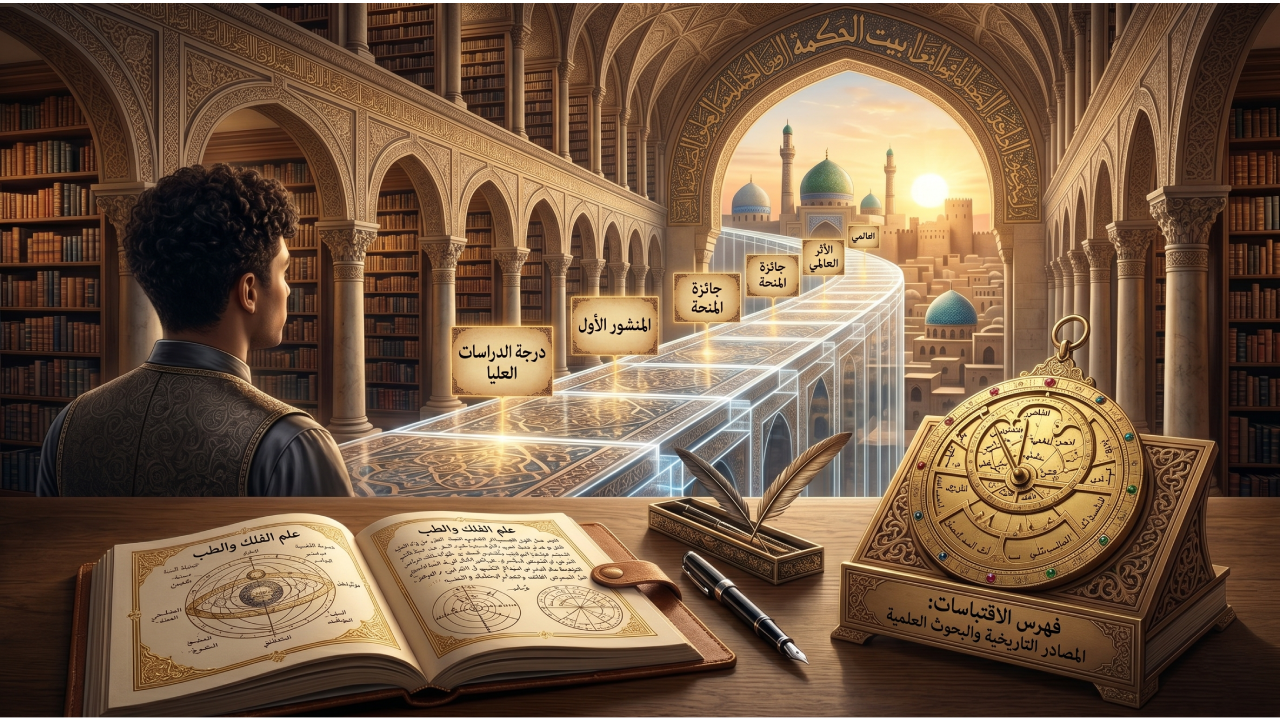


Cultivating the Intellectual Class That Will Carry the Mission Forward
INTRODUCTION: THE HUMAN FOUNDATION OF INTELLECTUAL WORK
No intellectual institution can sustain itself without people. Ideas do not exist independently of those who produce, refine, challenge, and preserve them. The most elaborately constructed research infrastructure will amount to little if the scholars who inhabit it are underdeveloped, isolated, or disoriented by the competing demands of the age. For this reason, the long-term success of the Research and Intellectual Development Wing depends not primarily on structures, processes, or funding, but on the formation of human beings capable of sustaining its mission across time.
This is not a peripheral concern. It is the foundational one. The Abbasid caliphate’s Bayt al-Hikma — the House of Wisdom established in Baghdad during the eighth and ninth centuries — was remarkable not because of the building that housed it, but because of the scholars it gathered and the intellectual culture it cultivated. Al-Kindi, al-Khwarizmi, Hunayn ibn Ishaq, and their contemporaries did not simply translate Greek and Persian texts into Arabic: they extended them, corrected them, and subjected them to entirely new frameworks of analysis. That output shaped European intellectual life for centuries. What made Bayt al-Hikma endure in its influence, long after its physical destruction by the Mongols in 1258, was the tradition of scholarship it had already transmitted — the methods, the questions, the habits of mind.
This chapter outlines how the organisation intends to cultivate intellectual talent and define long-term objectives that ensure continuity, depth, and relevance across generations. It takes seriously the proposition that institutional quality is ultimately a function of human quality — and that investing in scholars is, therefore, the most consequential investment the Research Wing can make.
THE NEED FOR A STRUCTURED SCHOLARLY CLASS
Throughout history, enduring civilisations have been sustained by organised bodies of thinkers, scholars, and intellectuals who dedicated themselves — often at considerable personal cost — to understanding and shaping their societies. This is not incidental. It reflects a deep structural reality: civilisations that fail to reproduce their intellectual class eventually lose the capacity to understand themselves.
The medieval Islamic world understood this acutely. The institution of the madrasa, which spread from Khurasan through the Arab world and into sub-Saharan Africa from the tenth century onward, was not primarily a religious institution in the narrow sense. It was a mechanism for producing a class of trained minds capable of sustaining the complex legal, theological, philosophical, and administrative life of a distributed civilisation. At its peak, institutions such as the Nizamiyya in Baghdad and al-Qarawiyyin in Fez — the latter widely regarded as the world’s oldest continually operating university — trained jurists, administrators, poets, and natural philosophers simultaneously. The waqf endowment system that funded them was itself an institutional innovation: a legal mechanism designed to protect intellectual infrastructure from the short-term pressures of political economy.
In the contemporary context, however, intellectual work among Muslim communities is severely fragmented. Traditional scholars operate largely within religious institutional networks — seminaries and mosques — with limited engagement with modern analytical disciplines. Academics function within secular university systems that are structurally indifferent, and often subtly hostile, to the civilisational questions most relevant to Muslim societies. Independent researchers and public intellectuals work in isolation, without the institutional support that would enable their work to accumulate and build over time. The result is a landscape of dispersed intelligence that, for all its individual brilliance, rarely produces the sustained, coherent intellectual output that shapes institutions and cultures.
The objective of this wing is not to replace existing scholarship but to create an environment in which traditional scholars, academics, independent researchers, and analysts can contribute within a unified intellectual ecosystem. Such a system allows knowledge to accumulate rather than remain scattered — to build rather than repeat.
The challenge is not a shortage of intelligent people. It is the absence of an institutional framework capable of directing, connecting, and sustaining their work toward shared long-term goals.
IDENTIFYING AND NURTURING TALENT
The development of scholars begins with the capacity to identify individuals who demonstrate genuine intellectual potential — curiosity that survives the absence of external reward, discipline capable of sustaining long-form research, and the kind of moral seriousness that makes intellectual work feel like a vocation rather than a profession. These qualities are not always visible through conventional academic credentials. Some of the most significant contributors to any serious intellectual tradition have come through unconventional pathways.
Ibn Khaldun, whose Muqaddimah stands as one of the most sophisticated works of social theory ever produced, developed his framework largely through direct observation of political collapse and social change — not through the established scholarly institutions of his day. He held administrative posts, survived political exile, and negotiated with Tamerlane before completing the theoretical work for which he is remembered. The conditions that formed him were adversity and breadth of experience, not institutional comfort. A contemporary talent-identification process must therefore look beyond formal credentials to identify the intellectual disposition that produces enduring work.
Potential scholars may emerge from universities and academic institutions, madaris and traditional learning environments, independent research communities, and increasingly from digital platforms and intellectual forums — spaces that have, in recent years, produced serious thinkers who would not have had a platform in previous generations. The organisation must create clear pathways for such individuals to engage in structured research work, including mentorship programmes, research fellowships, collaborative projects, and intellectual workshops through which emerging researchers are brought into genuine intellectual work rather than deferred to subordinate positions indefinitely.
The goal is to develop individuals through a recognisable trajectory: from learner to contributor, and eventually to leader of intellectual work. This is not a rapid process. The formation of a serious scholar takes years of deliberate effort. But without a structured pathway, even highly capable individuals default to whatever institutional environment will have them — often at the cost of the broader intellectual project.
THE MADRASA PIPELINE: STRUCTURED RECRUITMENT AND INSTITUTIONAL DEVELOPMENT
While talent may emerge from many sources, the Research Wing’s primary pipeline for scholarly recruitment will be the madrasa network. This is not a decision of convenience or sentimentality. It reflects a considered judgement about where the deepest reservoir of available intellectual potential currently resides — and where, with deliberate institutional investment, a sustainable supply of trained scholars can be developed over time.
Madaris possess several structural advantages that no alternative recruitment pathway can easily replicate. They produce graduates with serious grounding in the classical Islamic sciences — the very tradition that the Research Wing is committed to engaging rather than bypassing. They operate within communities where intellectual work is genuinely valued rather than merely instrumentalised. And they exist, in significant numbers, across all four of the regions with which this organisation is primarily concerned. The challenge is not their existence but their current configuration: a general-purpose curriculum that produces graduates competent across a broad range of religious sciences but deeply specialist in none of the analytical domains the Research Wing requires.
The model proposed here addresses this directly. Rather than treating the existing madrasa network as a passive recruiting ground, the organisation will engage with selected madaris as institutional partners in a deliberate programme of intellectual specialisation.
Subject-Specific Madrasa Development
The infrastructure of selected madaris will be developed — through financial support, curriculum design, and the provision of specialist faculty — to produce graduates with mastery of specific analytical subjects. Rather than attempting to develop a single institution capable of producing expertise across all relevant domains, the model distributes specialisation across multiple institutions, each of which builds genuine depth in a defined area.
The domains of specialisation may include, but are not limited to:
- Political systems, governance theory, and the history of Islamic political thought
- Economic systems, Islamic finance, and alternative development frameworks
- International relations, geopolitics, and the theory of civilisational conflict
- Media studies, narrative analysis, and the sociology of public discourse
- Legal and institutional frameworks, including comparative jurisprudence
- Sociology, identity formation, and the study of community structure under pressure
Each specialised madrasa will not abandon its foundation in the classical sciences — that would defeat the purpose. The integration of modern analytical disciplines into a curriculum grounded in Islamic epistemology is precisely the intellectual synthesis the Research Wing requires its scholars to embody. What changes is the depth to which each institution pursues a specific contemporary domain alongside its classical core.
The selection of which madaris to develop will be guided by demonstrated academic seriousness, institutional stability, geographic significance, and the quality of existing faculty. Top-tier madaris — those with the strongest existing track records of producing disciplined scholars — will be prioritised, on the straightforward grounds that institutional investment is most productive where strong foundations already exist. Development resources are not unlimited, and they must be concentrated where they will generate the highest return in scholarly quality.
Open Recruitment: Beyond the Madrasa
The centrality of the madrasa pipeline does not make it exclusive. The Research Wing requires domain expertise across a range of fields, and some of that expertise will necessarily be recruited from outside the traditional religious education system. Specialists in economics, political science, international law, data analysis, and the natural sciences — wherever they are formed — are welcome contributors to the Research Wing’s work, provided they demonstrate the intellectual seriousness and civilisational orientation the Wing requires.
This openness is both principled and practical. Principled, because intellectual quality does not recognise institutional boundaries, and the Research Wing would impoverish itself by confining its recruitment to a single educational tradition. Practical, because certain forms of technical expertise — quantitative economic modelling, for example, or international legal practice — are simply not produced by the madrasa system and cannot be replicated by it within any realistic timeframe.
The relationship between madrasa-trained scholars and domain specialists recruited from other backgrounds must therefore be one of genuine intellectual partnership rather than hierarchy. Madrasa graduates bring depth in the classical tradition and the civilisational grounding that contextualises all other analytical work. Domain specialists bring technical competence and familiarity with contemporary institutional frameworks. The Research Wing’s intellectual output depends on both, and the culture of the Wing must reflect this.
Public Expertise Framework and Open Application
Given the financial constraints that will inevitably limit the number of madaris whose infrastructure the organisation can develop directly, the model must extend beyond the institutions the organisation can support. To this end, the organisation will publish a comprehensive and regularly updated framework of expected expertise: a public document specifying, for each domain of research, the competencies, methodological orientations, and knowledge combinations that the Research Wing is seeking to recruit.
This public framework serves two functions. First, it enables any madrasa — including those the organisation is not in a position to develop directly — to orient its curriculum toward producing graduates who meet the Research Wing’s requirements. Second, it enables individuals from any background to assess their own suitability and prepare themselves accordingly. The decision to hire or not hire any particular candidate will be made on the basis of demonstrated competency against the published framework, regardless of the institution — madrasa, university, or otherwise — through which that competency was developed.
This creates a market-like dynamic in which the standards of the Research Wing exert influence on the broader educational landscape without requiring the organisation to bear the full cost of that influence. Institutions that develop the capacity to meet those standards will find their graduates employable. Individuals who develop the right combination of classical grounding and contemporary analytical expertise will find a pathway into the Research Wing’s work. The organisation incentivises quality without monopolising its production.
Students from all madaris — regardless of whether their institution has received direct development support — may apply for any role within the Research Wing for which they can demonstrate relevant competency. The application process must be structured to assess genuine intellectual capability rather than to function as a filter for institutional prestige. A graduate of a small, underfunded madrasa who has independently developed serious analytical competence in a relevant domain must have the same realistic prospect of appointment as a graduate of one of the top-tier institutions the organisation has invested in directly.
A Self-Renewing Scholarly Ecosystem
The long-term vision of this pipeline is not simply the recruitment of individual scholars but the creation of a self-renewing ecosystem. As the Research Wing develops its own track record and institutional standing, its alumni — scholars who have spent years working at the frontier of the Wing’s intellectual project — will themselves become resources for the madaris that supply it. Senior researchers who return to teach, even part-time, bring with them the analytical frameworks, methodological standards, and intellectual questions that the Research Wing has developed. This creates a feedback loop in which the organisation’s own intellectual development continuously raises the quality of the pipeline that supplies it.
This model has historical precedents. The relationship between al-Azhar and the broader network of Egyptian and regional Islamic institutions across centuries demonstrates how a single institution of sufficient intellectual standing can shape an entire educational ecosystem without formally controlling it, simply by establishing standards to which others aspire. The Research Wing’s ambition, in this respect, is analogous: not to dominate the madrasa network, but to become the institution whose standards define what serious scholarly formation looks like.
INTEGRATING CLASSICAL AND CONTEMPORARY KNOWLEDGE
One of the most significant intellectual fault lines in the contemporary Muslim world runs between traditional Islamic scholarship and the disciplines that have come to dominate modern intellectual life — political science, economics, sociology, international relations, and the natural sciences. This divide is not simply a matter of curriculum. It reflects a deeper structural separation: two intellectual traditions that have developed largely in isolation from one another for well over a century, each producing scholars who are often fluent in their own domain while remaining genuinely unfamiliar with the other.
On one side stand scholars trained in the classical Islamic sciences — Quranic exegesis, hadith methodology, jurisprudence, theology, and Arabic literary tradition. This training produces individuals with deep grounding in the intellectual heritage of the civilisation and a sophisticated understanding of its normative framework. But it frequently leaves them without the analytical tools to engage critically with modern political economy, institutional design, or empirical social science.
On the other side stand academics trained in Western universities — often brilliant analysts of contemporary systems, but lacking meaningful engagement with the Islamic intellectual tradition. Their frameworks for understanding political authority, economic behaviour, or social cohesion are derived almost entirely from the post-Enlightenment European intellectual canon. This is not a failure of intelligence. It is a structural consequence of how knowledge has been organised and transmitted in the modern period.
The scholars of the translation movement in ninth-century Baghdad did not simply adopt Greek philosophy wholesale. They engaged with it critically, retained what was compatible with Islamic epistemological commitments, modified what was useful but inconsistent, and discarded what was incompatible. Al-Ghazali’s Incoherence of the Philosophers demonstrates a thinker who had mastered the tradition he was critiquing. Ibn Rushd’s response demonstrates a thinker equally at home in both. This kind of intellectual bilingualism — the capacity to move fluently between different knowledge systems without losing one’s analytical bearings — is precisely what the madrasa development programme and the Research Wing’s broader recruitment strategy are designed to cultivate.
DEVELOPING SPECIALISATION ACROSS DOMAINS
The integration of classical and contemporary knowledge does not preclude specialisation. Indeed, as the Research Wing grows, genuine specialisation becomes not merely desirable but necessary. No institution can produce serious analytical work across every relevant domain simultaneously. The danger lies not in specialisation itself, but in a form of specialisation so narrow that it loses the ability to communicate across disciplinary boundaries.
The IIIT — the International Institute of Islamic Thought, established in 1981 — represents an instructive precedent. Its founding generation recognised that the intellectual crisis of Muslim societies required not simply the application of classical scholarship to modern problems, but a fundamental reconceptualisation of how knowledge itself is organised and valued. Their programme of the Islamisation of Knowledge was not without its critics, and its limitations have been extensively analysed. But the institutional impulse behind it — the recognition that specialisation must be embedded within a larger integrative project — was correct. The Research Wing builds on that impulse with a more empirically grounded and institutionally sophisticated framework: one that embeds specialisation within the madrasa development model described above, ensuring that depth in any given domain is always formed alongside, not instead of, the classical foundation.
Specialisation ensures depth. Collaboration ensures coherence. The Research Wing must build both simultaneously — and must resist the institutional tendency to allow specialised departments to develop into isolated silos that cease to communicate with one another.
BUILDING A GLOBAL INTELLECTUAL NETWORK
The challenges facing Muslim communities are not confined to a single country, region, or civilisational context. The question of political authority in a majority-Muslim state governed under secular constitutional frameworks raises different considerations from the same question as it presents itself to a Muslim minority community in a Western democracy. The economic conditions facing the Muslim communities of sub-Saharan Africa differ substantially from those facing the Gulf states, the South Asian diaspora, or the post-Soviet Muslim populations of Central Asia. A research programme that addresses only one context will produce analysis that is locally useful at best and dangerously misleading when exported beyond its conditions of origin.
For this reason, the Research Wing must build a genuinely global network of scholars — individuals who contribute from different regions, bring diverse analytical perspectives, understand local realities with the precision that only sustained presence can provide, and collaborate on shared intellectual goals that transcend their particular context. The ijaza system of classical Islamic scholarship — whereby scholars received formal authorisation to transmit specific texts from teachers who had themselves received such authorisation — created a global network of intellectual relationships that spanned from Andalusia to Central Asia. The contemporary equivalent requires collaborative research projects, joint publications, shared databases, and regular convening. Modern communications technology makes this substantially easier than it was for previous generations. What is required is the institutional will to invest in these relationships systematically.
THE ROLE OF THE STRATEGIC COUNCIL IN INTELLECTUAL DIRECTION
The relationship between intellectual independence and institutional direction is one of the most delicate problems in the organisation of any serious research body. Scholarship that is perpetually subordinated to institutional objectives loses its capacity for genuine inquiry. Scholarship that operates in complete isolation from institutional realities risks becoming irrelevant. The Strategic Council’s role is therefore one of broad direction rather than detailed prescription — identifying yearly priorities, five-year milestones, and decade-long strategic goals, within which the Research Wing exercises genuine intellectual independence.
A useful analogy is the relationship between a funding body and an independent research institution. The Rockefeller Foundation, in the early decades of the twentieth century, shaped the direction of American medical research by deciding which areas to fund — not by directing individual researchers to reach particular conclusions. The Research Wing must develop a similar relationship with the Strategic Council: one in which the Council sets the broad context and the Wing exercises genuine autonomy within it. What the Strategic Council must resist is the temptation to intervene in intellectual work when its conclusions are inconvenient or its pace is slower than expected.
SUSTAINING INTELLECTUAL INDEPENDENCE
For scholarship to remain credible, it must be protected from undue influence — and the sources of such influence are more varied and subtle than they might initially appear. Financial pressure, political interests, media narratives, and institutional bias can all distort research agendas in ways that are difficult to detect precisely because they operate through the selection of questions rather than the manipulation of answers.
The protection of intellectual independence requires both structural safeguards and a deliberately cultivated institutional culture. On the structural side: transparent policies governing funding sources, a clear separation between the Wing’s analytical outputs and the political or advocacy positions of other wings, and a formal mechanism through which researchers can raise concerns about undue influence without professional consequence. On the cultural side: an environment in which evidence is systematically prioritised over opinion, genuine inquiry is valued over the reproduction of established positions, and long-term understanding is treated as categorically more important than short-term relevance.
Intellectual independence is not the absence of institutional context. It is the commitment to letting evidence, rather than interest, determine conclusions — even when those conclusions are uncomfortable for the institution that houses the research.
LONG-TERM OBJECTIVES OF THE RESEARCH WING
The work of the Research Wing must be oriented by long-term objectives that provide direction without foreclosing the genuine intellectual inquiry through which those objectives are pursued. These objectives are horizons toward which the Wing consistently orients itself, understanding that the path to each will be determined by the work itself.
1. Building a Recognised Intellectual Institution
Over time, the Research Wing should develop into a credible intellectual body known for producing disciplined, serious scholarship that engages honestly with difficult questions. The Centre for Strategic and International Studies, the Carnegie Endowment for International Peace, and comparable institutions have built this kind of credibility not through any single publication but through decades of consistent output held to a consistent standard. The Research Wing must develop a comparable long-term reputation — built through its own sustained contribution, not borrowed from existing institutions.
2. Developing Foundational Literature
No intellectual tradition can sustain itself without a body of literature that others can build upon, critique, extend, and transmit. The Research Wing must therefore prioritise foundational texts: books, research papers, and conceptual frameworks that contribute to a growing intellectual tradition. Scholars such as Syed Abul Ala Maududi, Sayyid Qutb, and Fazlur Rahman produced works — whatever one’s assessment of their conclusions — that fundamentally shaped the landscape of twentieth-century Islamic thought. The Research Wing must aspire to a similarly foundational role.
3. Influencing Thought and Discourse
The influence of serious intellectual work on public discourse operates through long chains of mediation: research shapes the thinking of policymakers, educators, and journalists, who in turn shape public understanding. The goal is not to dominate media cycles or achieve viral prominence, but to gradually shift the terms within which important questions are understood — to make certain frameworks of analysis so well-developed and well-evidenced that they become difficult to ignore.
4. Supporting Institutional Development
The Research Wing does not exist in isolation. Its intellectual outputs are the primary resource through which the organisation’s other wings — Media, Outreach, Business, and the Strategic Council itself — develop the conceptual clarity necessary to act effectively. This support function must be understood as a genuine intellectual contribution, not a service role.
5. Preserving Intellectual Continuity
The history of Muslim intellectual life is marked by recurring episodes of discontinuity — the destruction of libraries, the disruption of scholarly networks, the interruption of transmission chains — that forced each generation to partially reconstruct what the previous one had built. The Research Wing must treat the prevention of such discontinuity as a structural priority. The madrasa development programme described earlier in this chapter is, in part, a mechanism for this: by building scholarly depth into multiple institutions simultaneously, the organisation distributes the risk of institutional discontinuity rather than concentrating it in a single point of failure.
GENERATIONAL CONTINUITY AND INSTITUTIONAL MEMORY
One of the greatest structural risks faced by any ambitious intellectual project is discontinuity — the gap between one generation of scholars and the next through which accumulated knowledge, established methodologies, and hard-won analytical frameworks can be lost. The Andalusian intellectual tradition, which produced Ibn Rushd, Ibn Tufayl, and Ibn Bajja in a single generation, was essentially extinguished within a century by a combination of political collapse and the failure to institutionalise its transmission.
To avoid this fate, the Research Wing must maintain:
- Robust archival systems preserving not only published outputs but working papers, internal debates, and the reasoning behind significant intellectual decisions.
- Deliberate mentorship structures creating sustained relationships between senior and junior scholars, in which intellectual formation and methodological transmission are treated as core institutional activities.
- Documentation of intellectual processes and the evolution of analytical positions over time, providing future scholars with the context necessary to extend or critique prior work productively.
- Structured knowledge-transfer systems — seminars, reading groups, joint research projects, and formal review processes — creating multiple overlapping channels through which institutional knowledge is transmitted.
The objective is to ensure that each generation inherits not merely the conclusions of its predecessors but their methods, their questions, and their habits of mind. This is what makes intellectual traditions endure: not the preservation of a fixed body of knowledge, but the transmission of a living way of approaching problems.
THE ROLE OF DISCIPLINE AND PATIENCE
Intellectual development is inherently a long-term process, and the Research Wing will operate in an environment that is structurally hostile to the timescale it requires. The contemporary media landscape rewards speed over depth, novelty over rigour, and confident assertion over careful qualification. Against these pressures, scholars must cultivate patience in research, discipline in methodology, consistency in output, and humility in inquiry.
These virtues are not simply matters of personal character. They must be institutionally supported. An organisation that publicly celebrates its most recent publication without equally valuing the years of preparatory work that produced it will gradually erode the commitment to that preparatory work. A culture that treats internal intellectual disagreement as a threat to institutional unity will produce conformity rather than quality. The Research Wing must deliberately cultivate the opposite.
The objective is not rapid recognition but sustained contribution. The scholars of the Abbasid golden age were not working for the news cycle of their day. They were working for posterity — and it is to posterity that the Research Wing must ultimately orient itself.
CONCLUSION: BUILDING THE MINDS BEHIND THE MISSION
The Research and Intellectual Development Wing ultimately depends on the people who dedicate themselves to its mission. Structures, funding, and systems provide the conditions for intellectual work, but they cannot substitute for the human qualities that make it possible: curiosity, discipline, integrity, and the willingness to pursue difficult questions beyond the point at which easier alternatives are available.
The madrasa pipeline, the open expertise framework, and the global scholarly network described in this chapter are not parallel strategies. They are complementary layers of a single coherent system — one designed to draw on the deepest available reservoirs of intellectual talent, develop that talent through structured investment, and connect it across disciplinary and geographical boundaries into a unified intellectual force.
By identifying talent through pathways that look beyond conventional credentials, developing madrasa infrastructure to produce domain-specific scholarly expertise, maintaining open recruitment for all capable individuals regardless of educational background, and building the generational continuity mechanisms through which accumulated knowledge survives institutional disruption, the organisation seeks to cultivate an intellectual class capable of guiding institutional development across generations.
This is not a task that can be completed. It is a task that must be continuously renewed — each generation of scholars taking responsibility for the formation of the next, each body of research creating the foundations upon which subsequent research can build.
If ideas shape institutions, then scholars shape ideas. And if institutions are to endure, the development of scholars must remain the central, non-negotiable priority of everything this organisation seeks to build.
The work begins here. Its completion belongs to those who have not yet arrived.