


This essay is not written to provoke guilt, nor to issue blanket verdicts. It is written to examine Should Muslims Reside in the West? a difficult question that many Muslims quietly wrestle with but rarely discuss openly: what is lost—personally, generationally, and collectively—when Muslims choose to permanently reside in the modern West?
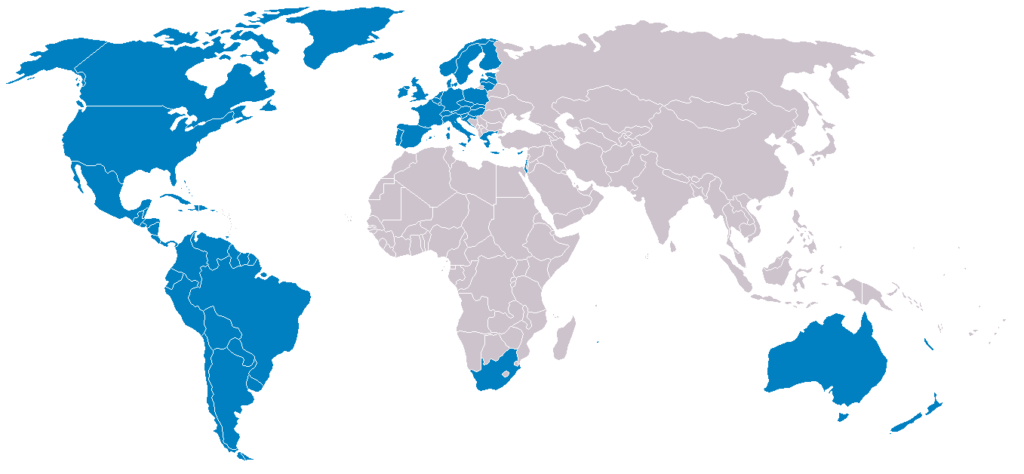
Before proceeding, it is important to clarify what is meant here by “the West.” For the purpose of this discussion, the term refers broadly to the United States, Canada, Australia, New Zealand, and most European countries (excluding the Balkans and Belarus).
The Ethical Cost of Residence
One unavoidable reality of living in Western states is material participation in their political and economic systems. Through taxation, labour, consumption, and intellectual contribution, residents help sustain these systems—whether they personally agree with state policies or not.
Over the past decades, Western powers have been directly or indirectly involved in wars, sanctions, and interventions across the Muslim world: Iraq, Afghanistan, Libya, Syria, Lebanon, and Palestine, among others. These actions have resulted in immense civilian suffering, displacement, and long-term destabilisation. Sanctions alone have cost millions of lives, often with little distinction made between combatants and civilians.
To acknowledge this reality is not to claim individual guilt for state violence. Rather, it is to recognise moral entanglement. When one’s tax contributions and professional labour sustain systems that repeatedly harm Muslim populations, an ethical tension arises that cannot be ignored indefinitely.
This tension becomes sharper when these actions are justified, normalised, or forgotten within dominant political narratives—while Muslim suffering is treated as collateral, distant, or unavoidable.
Economic and Ideological Conflict
Another dimension of concern lies in the foundational values of Western economic and social systems.
The modern Western economy is structurally built upon interest-based finance (riba)—a practice explicitly prohibited in Islamic ethics. Participation in such systems often becomes unavoidable, whether through banking, mortgages, pensions, or investment structures.
Beyond economics, there exists a deeper ideological divergence. Western moral frameworks are largely rooted in secular, evolving, and human-constructed ethics. Islamic ethics, by contrast, are grounded in divine revelation and moral limits that are not subject to social fashion.
This divergence manifests in areas such as:
- sexual norms,
- family structure,
- individualism,
- consumerism,
definitions of freedom and identity.
Living within a system whose moral assumptions fundamentally conflict with one’s own inevitably creates pressure—sometimes subtle, sometimes overt—to adapt, compartmentalise, or compromise.
The Generational Question
Perhaps the most serious consideration is the long-term impact on children and future generations.
No parental effort, however sincere, exists in isolation from the surrounding social environment. Schools, peers, media, and public culture all play formative roles. Over time, these influences can normalise values that are incompatible with Islamic teachings, including permissive attitudes toward sexual relations, substance use, radical individualism, and identity frameworks detached from faith.
While exceptional individuals do exist, exceptions cannot be treated as norms. Statistically and sociologically, prolonged exposure to dominant cultural forces reshapes beliefs, priorities, and identity—often quietly and gradually.
The question is not whether some families succeed in preserving faith, but whether such preservation is structurally supported or structurally resisted by the surrounding society.
Dignity and Belonging
There is also a question of self-respect and belonging. Muslims in the West often find themselves attempting to integrate into societies that simultaneously portray Islam as a security concern, a cultural problem, or a civilisational rival.
When acceptance is conditional and belonging is fragile, one must ask: what does it mean to struggle for inclusion in spaces that remain uneasy with your presence?
Situations Where Residence May Be Justified.
This essay does not argue that living in the West is always impermissible or unjustifiable. Context matters. There are circumstances in which residence may be strategically or ethically defensible, including:
1. Economic Necessity
When individuals or families are burdened by severe financial instability—particularly debt that cannot be resolved within non-Western economies—temporary residence for employment may be justified. The intention, however, should be financial recovery and exit, not permanent settlement.
2. Business and Strategic Engagement
Western economies are consumption-driven and globally influential. Establishing businesses, expanding markets, or engaging strategically may serve broader Muslim interests—especially when aimed at reducing dependency, increasing leverage, or countering hostile economic influence.
3. Advocacy and Lobbying
Presence within Western political and economic centres can, in some cases, allow for advocacy on Muslim issues and resistance to powerful donor networks that shape policy against Muslim interests. This requires clarity of purpose and ethical discipline.
4. Medical Necessity
Where adequate medical treatment is unavailable in Muslim or non-Western countries, seeking care abroad is a legitimate and humane consideration.
5. Education (With Strong Reservations)
Priority should be given to educational institutions within Muslim countries. Western universities may be considered only when:
- educational gaps are demonstrably significant, and
- safeguards are in place to protect faith, identity, and moral grounding.
Education should be treated as a means, not an uncritical endorsement of cultural assimilation.
Concluding Reflections on Should Muslims Reside in the West?
This is not a call for mass departure, nor a condemnation of individuals. It is an invitation to honest self-examination.
Every choice has consequences—not only for oneself, but for children, communities, and the Ummah at large. The question is not simply where can I live comfortably, but where can I live responsibly, with integrity, and with awareness of long-term impact?
Strategic thinking requires more than immediate benefit. It demands that Muslims assess residence, participation, and belonging through ethical, generational, and civilisational lenses.
The answer will not be identical for everyone—but the question deserves to be asked seriously.
You may check our presented idea to strengthen the Ummah.